
The fire is on one floor. The smoke shows up twenty floors above it.
Every member who has worked a high-rise job in January knows the stack effect. It's cold outside and warm inside, and the building turns into a chimney. Air moves up the stairwells and elevator shafts, and smoke from a fire on a low floor ends up on floors that are nowhere near it.
What makes it dangerous is that you can't see it from where you're standing. The fire floor looks like the whole problem. But there are people in trouble far above it, on floors with no fire, and the taller the building, the worse it could get.
Your tax return works the same way. The fire floor is the tax-deferred money you aren't touching at 60. The smoke shows up at 75 and 80, on a return you haven't filed yet.
The size-up
Take a hypothetical retired Captain. He is 60, married, and lives in New York. His wife doesn't work. His pension is $15,000 a month and he collects the $12,000 VSF. He lectures about forty days a year, which adds another $40,000.
He also has two pots of tax-deferred money: $1,000,000 in deferred comp, and $750,000 of pension excess that he rolled to an IRA when he retired. He doesn't spend the investment money. The pension pays the bills.
That $1.75 million of investments isn't all his. He has a silent partner. Uncle Sam let him skip the tax on the way in, and in exchange he owns a share of every dollar and gets to decide later how big his share is.
On this year's return the Captain is in the 22% federal bracket, with about $20,000 of room before he reaches 24%. Nothing about that looks like a problem. Now leave both pots alone for fifteen years and assume they grow 6.5% a year. The age-75 figures are in projected future dollars
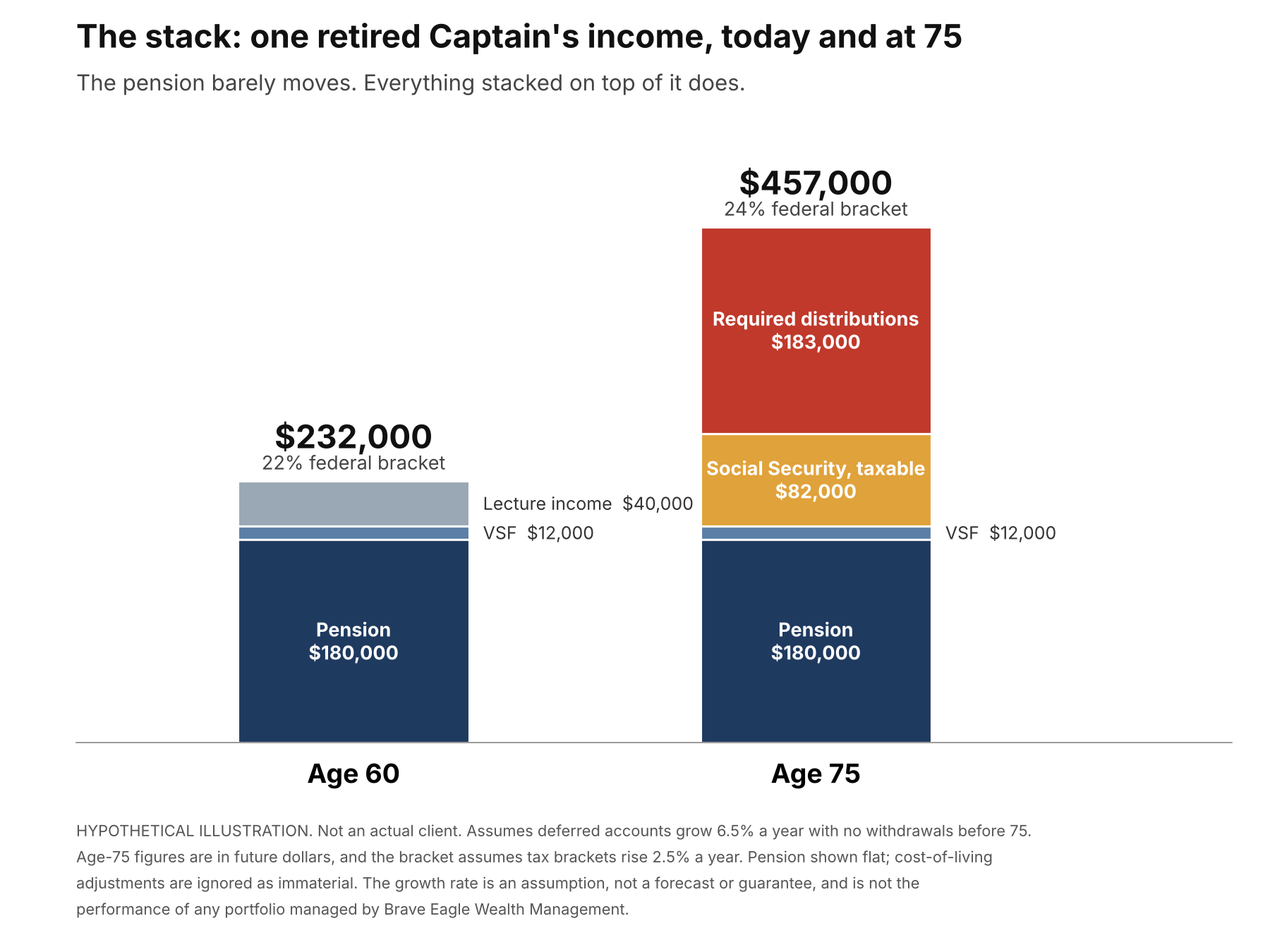
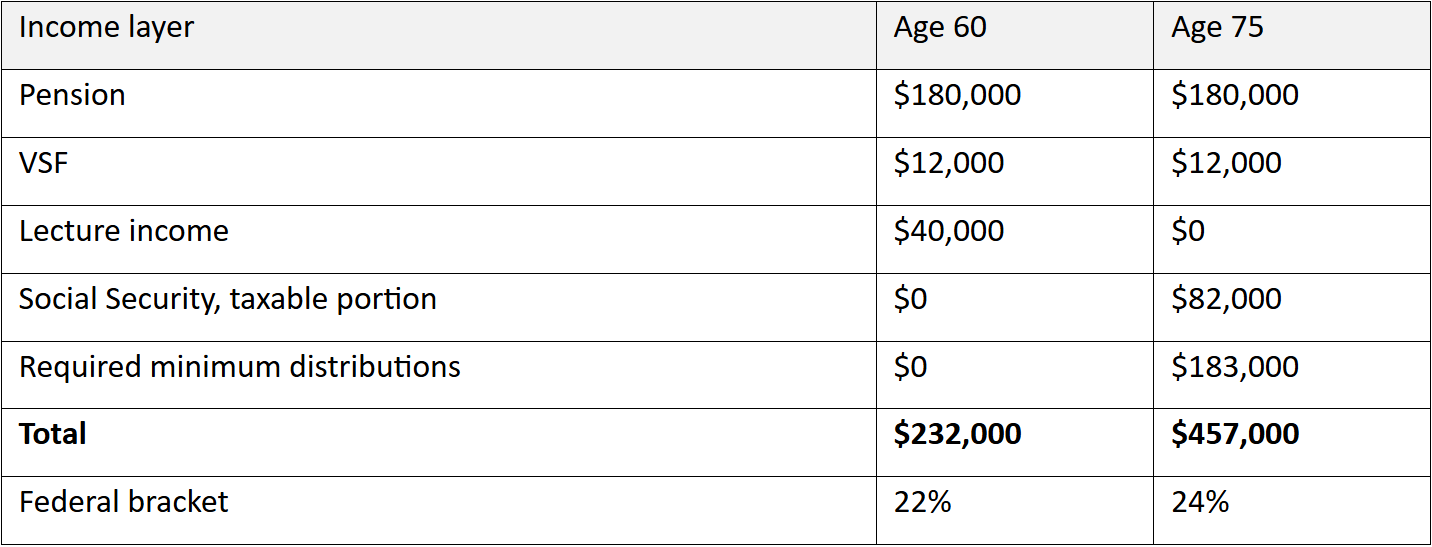
Look at the pension. It barely moves, and neither does the VSF. Everything stacked on top of it does. The $1.75 million of investments has become about $4.5 million, and at 75 the IRS makes him start taking it out. The first required distribution is about $183,000, and the required percentage goes up every year after that. He didn't ask for the money and he doesn't need it, but Uncle Sam wants to start collecting his share.
Tax brackets rise with inflation too, so $457,000 in 2041 is not what it is today. On a projected 2041 table he is in the 24% bracket. He goes from 22% to 24%. If that were the whole story, I wouldn't be writing this.
Where the smoke shows up
The joint return is the fire floor. The trouble is above it.
Sooner or later there is one name on the return. If it’s the Captain, he files single on nearly the same income, in brackets roughly half as wide. At 80 years old, even after the brackets have risen with inflation, this Captain is in the 35% federal bracket. Nothing about his finances changed except his filing status. If it’s her name, she inherits both pots and files single too.
There are two more floors above that. The forced distributions (RMDs) can push the couple over the income lines where Medicare premiums step up. And whatever the couple doesn't spend during their lifetime goes to the kids, who generally have ten years to empty it, on top of their own salaries, possibly during their peak earning years. If the kids are in a higher tax bracket than the tax bracket the parents were in when they could have converted, it's a win for Uncle Sam. Uncle Sam's partnership interest in the account increased.
Two pots, two sets of rules
Here is the part that is specific to the job. Federal law treats the Captain's two pots the same. New York does not.
The pension. New York doesn't tax it.
Deferred comp. New York taxes it like any other retirement account. Once you're 59½, the first $20,000 a year comes out free of state tax. That $20,000 doesn't carry forward. Use it by December 31 each year or it's gone.
Pension money rolled to an IRA. The amount you rolled over keeps its New York tax exemption. The growth on it does not.
Read that last one again. The exempt amount was set the day he retired, and it never gets bigger. Every year the account grows, a larger share of it becomes New York taxable. Left alone for fifteen years, most of that IRA could be growth, and if that is the case then most of it would be taxable.
Now put it together. Uncle Sam owns a share of all of it. New York owns a share of the growth.
A Roth conversion is buying your partners out, at this year's price. This year our Captain can move money to a Roth from both pots, in the right order, and pay 22% to 24% federal and little or nothing to New York. After that, all of the growth in the Roth IRA is his. Later it's his wife's, and after that his kids'.
Leave it where it is and both partners stay in. Uncle Sam's share only grows if the Captain's tax rate does, and everything in the stack is pushing that rate up. New York's share grows on its own, because the exempt amount is frozen and the account is not. Both collect at the top of the stack: 24% federal plus New York's 5% to 6% as a couple, and 35% plus New York when one of them is alone.
The buyout has a price. A conversion means paying the tax now, it can't be undone, and it could be the wrong move for someone who is leaving New York or expects lower income later.
It only works if the pots are kept separate and you can document what you rolled over. So here's a question for anyone who has been retired a while. Do you know your excess number? Do you know which account it is sitting in? Have you been paying New York income tax on money New York doesn't tax?
Do your own size-up
A size-up is a set of questions you answer before you commit. Here are five for your own building.
What is in each pot? Deferred comp and rolled-over pension money, counted separately.
How much did you roll over from the pension fund? The number, and the paperwork that proves it.
What bracket are you in this year, and how much room is left in it?
When does the side work stop? The day it does, room opens up.
What does your return look like with one name on it?
If you can answer all five, you're ahead of most retirees. If you can't, that's where the work starts. The answers are different for every member and they change every year, so this is something you revisit every fall, not something you do once.
Two things have a clock on them. This year's bracket room and this year's $20,000 New York exclusion are both gone on December 31, and nothing moves fast in December.
Brave Eagle Wealth Management is an FDNY retirement specialist. Our wealth management service includes investment management and year-round tax planning. If you want a second set of eyes on your size-up, call Emily Dimino in our office at 212-918-4760 to set up an appointment.
The Captain in this article is hypothetical and does not represent any client. Federal figures use 2026 brackets and the 2026 standard deduction (). Projections are in future dollars and assume 6.5% annual growth, no withdrawals before age 75, and Social Security of $45,000 and $22,000 in today's dollars claimed at 67. Social Security, the 2026 tax brackets and the standard deduction are all assumed to rise 2.5% a year. The 6.5% growth rate is an illustrative assumption. It is not a forecast or a guarantee, it does not reflect advisory fees, and it does not represent the performance of any portfolio or strategy managed by Brave Eagle Wealth Management. Results are sensitive to it: at 5% growth, the widowed Captain at 80 would be in the 32% bracket, not 35%. The pension is shown flat; cost-of-living adjustments are ignored as immaterial. Actual results will differ. New York treatment of rolled-over public pension money follows the Tax Department's published advisory opinions and depends on individual facts and records. This material is for informational purposes only and does not constitute tax or investment advice. Consult a qualified professional regarding your own situation.
