
Is Your “Safe” 3% Retirement Account Actually Keeping You Safe?
Why FDNY retirees should reconsider leaving retirement-sized balances in fixed and stable-value options.
For many FDNY retirees, the most reassuring line on a retirement statement is the account earning approximately 3%.
The balance appears stable. Interest is credited steadily. There are no alarming market headlines to follow. After a career spent taking risks, that stability has understandable appeal.
But there is an important difference between an account that maintains a stable balance and an investment that maintains your purchasing power.
A stable balance is not the same thing as stable purchasing power.
FDNY retirees generally have access to Stable Value type funds through the UFOA Annuity Plan and the NYC Deferred Compensation Plan. As of June 30, 2026, the fixed option within the UFOA Annuity Fund was crediting an annualized rate of 3.00%. The NYC Deferred Compensation Plan’s Stable Income Fund reported an annualized crediting rate of 3.25% for the first quarter of 2026.
Those are current crediting rates—not long-term returns that a participant can lock in. They apply for the stated period and may reset in future quarters. The rate available next year, three years from now or five years from now is unknown.
These options can serve a legitimate purpose for money that must remain stable and readily available. The problem is not in owning them. The problem is allowing a retirement-sized balance to remain there indefinitely without determining whether it still fits the retiree’s complete financial plan.
The number on your statement is not your real return
A fixed account’s crediting rate is a nominal rate. It tells you how many additional dollars are being credited during the current period. It does not tell you whether those dollars will buy more.
If an account earns 3% while inflation is also 3%, the balance grows—but its purchasing power does not. Its approximate real return is zero.
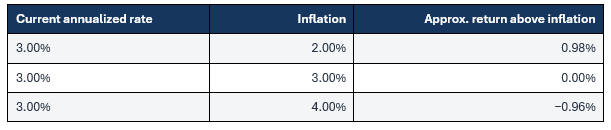
This matters especially for a Tier 2 FDNY retiree. The pension provides valuable lifetime income, but its purchasing power is significantly exposed to inflation.
If the retiree also keeps a substantial Deferred Compensation or UFOA Annuity Fund balance in a fixed account, two of the household’s largest financial assets may be exposed to the same risk.
The pension is nominal. The fixed account’s current rate is nominal and resettable. Inflation affects both.
What looks like a conservative allocation may actually be a concentrated bet that inflation will remain low—and that future crediting rates will remain attractive.
The U.S. Treasury is currently offering a different kind of return
Treasury Inflation-Protected Securities, commonly called TIPS, are issued by the United States Treasury. Their principal is adjusted based on changes in the Consumer Price Index, and they trade at a real yield—a return above inflation.
As of July 21, 2026, the U.S. Treasury reported the following real yields:
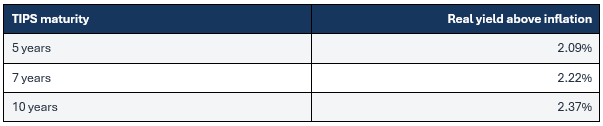
These are not yields of 2.09% to 2.37% before inflation. They are stated yields above inflation when the securities are purchased and held to maturity, subject to the mechanics of the bonds.
For example, if inflation averaged 3%, a five-year TIPS yielding 2.09% would produce an approximate nominal return of 5.15% before fees and taxes. More importantly, the investor would have locked in a return of approximately 2.09% above inflation.

No one knows what inflation will be over the next five years. That uncertainty is precisely what TIPS are designed to address. Future inflation adjustments are unknown, but the real yield established at purchase does not reset every quarter when an individual security is held to maturity.
The dollar difference can become meaningful
Consider a retired firefighter with $500,000 earning a current annualized rate of 3%.
At that rate, the account would earn approximately $15,000 during the first year if the rate remained in effect. If inflation were also 3%, however, the account would have earned approximately no increase in purchasing power.
A 2.09% real yield on $500,000 represents approximately $10,450 of additional purchasing power during the first year, before advisory fees, taxes and differences caused by the bond’s inflation-indexing mechanics.
That does not mean every retiree should move $500,000 into TIPS. It means a short-term 3% nominal crediting rate and a multi-year 2.09% real yield are not offering the same economic benefit—or the same certainty about future purchasing power.
A stable account is not a retirement plan
The decision is larger than choosing whichever investment displays the highest current rate. An FDNY retiree needs to answer several connected questions:
· How much money may be needed during the next one or two years?
· Which assets will fund planned portfolio withdrawals?
· How much of the retirement portfolio should be protected against inflation?
· How much long-term growth is needed over a retirement that may last 25 or 30 years?
· What happens if stocks decline shortly after retirement?
· How should Deferred Compensation, the UFOA Annuity Fund, the pension, Social Security and required distributions work together?
· Which assets belong in tax-deferred accounts, and which belong in taxable accounts?
No fixed account—and no individual TIPS bond—answers all of those questions. That requires a retirement-income portfolio.
How we use TIPS in an FDNY retirement portfolio
At Brave Eagle Wealth Management, we do not view TIPS as a standalone trade or as a prediction about the next inflation report.
We can use individual TIPS securities to construct a short-term maturity ladder. Different bonds mature in successive years, producing scheduled cash inflows that can help fund retirement distributions.
That structure may provide three important benefits:
Inflation protection. The securities are designed to preserve purchasing power while earning the real yield available when they are purchased.
Planned liquidity. Individual bonds mature on known dates and become cash, which can be coordinated with anticipated withdrawals.
Time for growth assets. When near-term distributions are supported by cash and maturing securities, a retiree may be less dependent on selling stocks during an unfavorable market.
That third benefit is critical. A retirement portfolio cannot focus exclusively on avoiding short-term fluctuations. It must also address the long-term risk that living costs rise faster than the portfolio.
A deliberately constructed portfolio can combine cash for immediate needs, individual TIPS maturities for an inflation-protected spending runway, equities for long-term growth, appropriate risk management, and coordinated tax and distribution planning.
The allocation should be built around the retiree—not selected because one account happens to feel comfortable.
Retirement should trigger a new portfolio decision
Many FDNY members accumulated money in Deferred Compensation or the UFOA Annuity Fund throughout their careers. When they retire, the account often remains invested exactly where it was.
That is understandable. Leaving the money in place requires no paperwork, no investment decision and no immediate change.
But convenience is not a financial plan—and the allocation used during a career does not automatically become the right allocation for retirement.
The right question is not simply, “Did this account lose money?”
The right question is, “Is this money doing the job I now need it to do?”
An active firefighter accumulating assets has different needs from a retiree drawing income, protecting purchasing power and coordinating several retirement assets. Retirement should trigger a fresh analysis of the entire structure.
The decision is larger than TIPS
We first wrote about the opportunity in TIPS in January 2023, when real yields had risen to their highest levels in more than a decade. Today, real yields are even higher.
But the lesson is not that every retiree should exchange one conservative investment for another. It is that retirement assets should be evaluated together.
For an FDNY retiree, that means analyzing the inflation exposure in the pension, current Deferred Compensation and annuity allocations, anticipated withdrawals, tax consequences, liquidity needs, investment risk and the need for long-term growth.
A fixed or stable-value option can be useful. Allowing hundreds of thousands of dollars to remain there indefinitely without performing this analysis may not be conservative at all.
Staying put is still an investment decision—even when it does not feel like one.
What does an FDNY retirement portfolio actually look like?
It is one thing to identify the limitations of leaving a retirement-sized balance in a fixed account. It is another to build a portfolio that balances purchasing-power protection, liquidity, long-term growth and risk management.
The Brave Eagle Risk-Managed Growth Strategy is designed to complement the FDNY pension. Our allocation combines:
· Equities for long-term growth
· TIPS for inflation protection and planned liquidity
· Active risk management
· Cash
As of June 30, 2026, approximately $116 million was managed within the strategy.
From its January 1, 2024 inception through June 30, 2026, the strategy generated a 14.54% annualized return net of fees, compared with 14.66% for its blended benchmark. The benchmark consists of 60% SPDR S&P 500 ETF Trust (SPY) and 40% Vanguard Short-Term Inflation-Protected Securities ETF (VTIP). Past performance does not guarantee future results.
The purpose of showing this result is not to suggest that every FDNY retiree should own the same portfolio. It is to show that inflation protection, liquidity, growth and risk management can be deliberately assembled into one retirement strategy—and that this is not merely a theoretical framework.
How Does Your Current Account Compare?
Investment performance is only one part of an FDNY retirement plan. The portfolio must also coordinate with your pension, taxes, withdrawals, inflation exposure and need for dependable liquidity.
Bring us your most recent Deferred Compensation or UFOA Annuity Fund statement. We will help you answer three questions:
1. What is your retirement account actually invested in?
2. How much return above inflation is it positioned to earn?
3. Does the allocation fit your pension, anticipated withdrawals and long-term retirement needs?
Sources and important information
Sources: U.S. Department of the Treasury, Daily Treasury Par Real Yield Curve Rates, July 21, 2026; The Annuity Fund of the Uniformed Fire Officers Association, Investment Performance as of June 30, 2026; City of New York Deferred Compensation Plan, Stable Income Fund disclosure for January 1–March 31, 2026; Brave Eagle Risk-Managed Growth Strategy fact sheet as of June 30, 2026. Rates and yields change. The examples are hypothetical, approximate and do not represent the performance of a client account.
Individual TIPS fluctuate in market value before maturity. Inflation adjustments and interest are subject to specific Treasury mechanics. The inflation-adjusted principal may decline during deflation, although Treasury provides a maturity floor based on original par. Selling before maturity may result in a gain or loss. Taxes, fees, liquidity needs, investment objectives and account restrictions should be considered before making a rollover or investment decision.
Investment advisory services are offered through Brave Eagle Wealth Management, LLC, a registered investment adviser. This material is for informational purposes only and is not individualized investment, tax or legal advice. Registration does not imply a particular level of skill or training. All investing involves risk, including possible loss of principal.
